Showing posts with label Food stories. Show all posts

Wednesday, October 12, 2016

To be (a chef) or not to be (a cook)

My mother always brags to her friends that I am the chef of the family. However, spending time in her kitchen not only gives me amazing cooking lessons, but makes me realize that I am not the ruler of the kitchen. That is not the first time I am called a chef, due to my exceptional cooking knowledge and abilities.I have been called "a great cooker" as well, by non-english speakers. To that statement I always responded with the most whimsical attitude, that I might be a skillful cook, but that does not make a pot! Still, there is something about the chef title I am awarded that cannot agree with me, and that is definitely not a vocabulary issue. 


It was during my search for my culinary identity when I met Costas. Him and his wife, Theodora, lived next door to my sister in a less than idylic village in Southern Crete.
Since the first day my ladles met Costas' knives, cooking has been a bewildering experience, as we shared the same passion for food and for exploring new tastes and techniques. 

In the meantime, Costas decided to pursue his passion for cooking through culinary school, while I continued to indulge into the gastronomic knowledge through books and practice. Although we were still capable of producing exquisite food, mainly for the satisfaction of Theodora and Menia, my sister, we developed a different approach to the culinary art. As I watched him measuring and weighing everything, even the amount of eggs he was using for his recipes, while I was still using ordinary cups and humble pinches, I started to realize that I was right to renounce the
title of a chef for myself. That realization brought up a question that has been tormenting me for a long time: how can a chef be different from a skilled cook? 

The answer has always been obvious to my enenlightened eyes. An elementary comparison of my culinary identity to that of a chef, proves that I am nowhere near the chef-dom.

From a linguistic standpoint, "chef" is the French word for captain, thus in the kitchen battlefield they are the leaders. As French culinary culture set the ground for the development of eclectic cuisine, it established its intrinsic vocabulary in gastronomy as well. Personally, it is not my lack of leading ingenuity that makes me a less than adequate candidate to rule the culinary kingdom, but the fact that the pressures of a professional kitchen are far from the relaxation and rejuvenation cooking is offering me.


The distinction of a chef in the wild realm of gastronomy depends not only on their leading skills, but on their creativity as well. The modernization of product transportation, as well as the advance of food preservation systems gave extensive access to uncommon alimentary commodities. That allowed chefs to give a unique flair to their dishes, allowing haûtes cuisines to be carried away from the basic cooking premise: cook with respect to your environment. Inspired by my environmental studies, I engage in choosing my cooking ingredients according to locality and seasonality. As much as I would love to respect the originality of Italian pasta, I always choose local cheeses over imported parmesan.
Photo retrieved from www.instagram.com/gastroart


Accuracy and replicability (if scientists allow us to use their jargon in such a common way), has always been a huge issue in the professional culinary world. The perfect cuts of vegetables, the right consistency of sauces and the attention to every single detail is what awards chefs stars and golden toques. Thus, the use of specialized tools is essential, in order to assure the premium result. I have to admit that when it comes to kitchen tools, I am tempted to purchase every fancy tool that I encounter at the stores. Although they make my cooking easier, there is nothing I cannot cook with only a pot, a sharp knife and a ladle, as issues like accuracy and meticulous presentation do not really matter. In the cozy environment of my kitchen, who cares if my pie today looks
the same as the one I prepared yesterday? If it tastes deliciously, the accurate slices of potatoes and the perfectly trimmed sides of the dough are not significant, as the smiles of satisfaction on the faces of your loved ones are the ultimate reward.

Furthermore, recipes for chefs are as essential as the tools they use. All their gastronomic wisdom lays hidden within their notebooks and the passing of that knowledge from the leading chefs to their younger protegés, is almost exclusive. On the other hand, home-cooks use any kind of recipe notebooks that are convenient (mine is an old daily calendar, with music lyrics on the page sides).
In addition, recipe sharing is performed in the most unique manners, usually over a relaxing glass of wine, a carefree cup of coffee or casual conversation.


Keeping all that in mind, I have decided that I will hold on to my colorful apron, instead of the monochromatic appearance of a professional cook.
I still reserve great consideration for the culinary connoisseurs and follow their wisdom respectfully. After all, as Katherine Neville explains in her novel "The Fire" cooks are blessed people, as they are the magicians of fire, responsible for feasting and sacrifices, thus the utmost respected professionals. Yet, I choose a more down-to-earth approach to my cooking and define myself as a humble cook, leaving the reins of chef-dom to Costas. 

The Greek poet Giannis Ritsos once recited in his work The Blackened Pot " ...we do not sing to distinguish ourselves from the rest of the world, my brother. We sing to bring the world together." Well my bother, allow me to rephrase the wise words of the poet and speak a great truth about humble cooks, who find joy in serving their loved ones food that stems primarily from the heart: we do not cook to distinguish ourselves from other cooks or the world, we cook to bring people together!


Sunday, October 12, 2014

Hey baklava girl... are you ready to marry?

The morning walk to Moscow Farmers' Market that Saturday had a surprise in store for me. I was showing my visiting parents the place that was hosting my new student adventures, when I heard an unfamiliar voice greeting me enthusiastically.

"Hey, I know you!" cheered a middle aged typical American male figure.

"I know you..." he continued. "You are the baklava girl!"

The Greek exhibition at the fair
As I explained to my parents this polite, but still strange man, was merely one of the many visitors of the booth representing Greece, I was holding in the International Students' Fair every year. The Fair was celbrating diversity among the world cultures and as a genuine Greek hostess I was treating my guests with a sweet bite of baklava. 

My guest's fervent greeting indicated two facts. First, my pastry cooking made a lasting impression on my booth vistors. Second, not only my cooking made me recognizable, but I had a nickname in the little town of Moscow, Idaho: the baklava girl! 
Baklava rolls (photo by Aditya Abburi)

The first question that might come to mind is how can a Greek girl, like me, be associated with a dessert that is Turkish, or at least Middle-Eastern. The truth is that the origin of baklava has been an issue of dispute among many countries in the areas around Greece. This sweet delicacy has been yet another reason for disagreement between Greeks and Turks. Who invented it first and who prepares it better? Both sides trace its roots in ancient desserts, like the Greek plakous, a pie with nuts and honey, or the treat from the Mongolian tradition, güllac. While one and the other historians have reasons to argue, they are probably engaging in a vain debate, as the  combination of dough, nuts and sweetening agent is one of the oldest recipes all around the globe.
Turkish version of baklava with pistachios
(photo retrieved from http://www.athinorama.gr)

The Turkish version of baklava is green. Thinly rolled phyllo dough wrapping a healthy serving of chopped pistachios, plunged in a sugar based ambrosial syrup create a divine dessert that has become the culinary symbol of Turkey. Thus, it was only fair that the Gaziantep baklava, named after the town that produces it, gained a protected status by the European Union, a title awarded only to a few products outside the official European boarders. 
Diamond-shaped baklava
(photo retrieved from http://ntrimy-oisydagesthsgiagias.blogspot.gr)

On the other side, Greeks choose the earthy colors of walnuts in combination with almonds for their baklava. On my island Lesvos, in particular, baklava is prepared on special occasions using only blanched almonds. One of those occasions is no other than the engagement. According to tradition, the bride has to prepare a big tray of baklava in order to please the groom's mother. Only if the mother in law is content with the result can she approve the wedding.


The cooking of baklava is a highly technical preparation, in which timing and choice of ingedients are crucial. The dough has to be paper thin, the almonds blanched and chopped correctly, the oil chosen among the finest qualities, the spices strong enough to flavor the dessert but not overpowering it and the syrup added at the perfect time to sweeten the dough, but still keep it crispy. The girl who manages to produce a perfectly balanced baklava can be consided ready to perform flawlesly in the kitchen and cater for her new household. If this tradition contradicts the fundamental premises of feminism, keep in mind that deep down Greek society is matriarchal. Thus, it is not just the future of a bride that is hidden between the layers of a diamond-shaped piece of baklava, but her ability to rule the family as well.

My skills regarding the preparation of baklava definitely made an impression on Moscow town dwellers. If I were a chef, I would probably claim that to be my signature dish. Whether my culinary aptitude on this matter proclaim me ready to enter the kingdom of mariage ... or not, will not be debated in this article. For the moment I will keep treating friends and visitors with the delight of a piece of baklava.      


Tuesday, May 13, 2014

Fabulus legumes, part 2: the hummus origins

Cari's visit went as smooth as I expected it to be. She and her family came with a healthy appetite to try local food and take a deep plunge into the flavors and the aromas of the Greek culinary world. They had the great fortune of visiting during the lent period for one main reason. In order for restauranteurs to maintain their fasting clientele, they adjust their menus to include some marvelous vegetarian dishes from the Greek cooking tradition.

"We want to taste everything Greek!" was the visitors' wish, which made me extremely happy.

"Everything! The Greek salad, the fava beans, the lamb, the Greek hummus...!"

Hummus? A thousand little bells started ringing in my head, forcing my memory cabinets open to spill any information I had on hummus. No indication on the Hellenic identity of this dish surfaced.

"Why do you think hummus is a Greek dish?" I asked Cari.

Hummus served with flat bread  (photo retrieved from www.tovima.gr)
Revelation and misunderstanding! Cari reminded me of that brand of edible products, commonly found in grocery stores all around the US, with the characteristically Hellenic name. Among the typical Greek products, like feta cheese, olives and pita bread, one of the company's best selling product is hummus. Obviously, the popularity of the product in the marketplace has created the belief to the consumers that the origin of hummus is Greek! As much as I would like to express my chauvinism by stating that everything stems from the Greek civilization, I could not falsely claim the originality of hummus on behalf of my culture. 
Garbanzo beans (photo retrieved from www.emprosnet.gr)

Hummus is a dip or a spread, with the basic ingredient being the garbanzo beans, mashed and flavored with tahini (sesame paste), a splash of lemon and some garlic. Although great Greek philosophers, like Socrates and Plato, praised the nutritional value of mashed garbanzos, the roots of hummus reside in the boisterous history of the Arab world. Even the name stems from the Arab language, as hummus is the word for chickpeas. It is difficult to tell which culture first created this delicacy, but there is definite proof of the recipe presence in a 13th century cookbook, discovered in Cairo. Since then, this food has become one of the most consumed dishes, not only in the Middle East, but around the world as well. 

A little poll among my group of peers revealed that Greeks do not clearly know what hummus is or which cuisine features it, fortifying the fact that this particular dish is not part of our cooking tradition. In a later conversation with my friend Maria, from the idyllic island of Zakynthos, I learned that hummus is actually served as an appetizer in tourist restaurants, as there is a popular demand for it. 

Yellow split peas
Then I remembered what one of my university professors, the late Nikos Margaris, wrote in one of his books, regarding Greek environment*. According to him, cooking tradition and practices in Greece are related to environmental factors. In older times, when electricity was not part of the cooking equation, ingredients that take a long time to cook, thus require a considerable amount of fuel, were part of the diet in areas where a lot of wood was available. Garbanzo beans need a lot of time to cook, thus they are commonly found in dishes of large islands, like Lesvos, where vast forests grew, providing adequate fuel material. Smaller islands though, had limited fuel resources, thus they had to choose a legume that is equally nutritious, but cooks faster. One such legume is split peas, which is commonly cultivated in smaller islands, like Santorini and Mykonos. As a matter of fact, Santorini split peas, or fava, is one of the most famous POD products of Greece.
Split pea puree served the Greek way

So, if you are planning a vacation in Greece, with the goal to taste Greek food, like Cari and her family, instead of hummus order fava. That is the split pea puree. Both Cari and I can assure you that it tastes deliciously!


* Μάργαρης, Ν.Σ. (2001), Οδοιπορικό στο ελληνικό περιβάλλον, Ελληνικά Γράμματα, Αθήνα

Wednesday, May 7, 2014

Fabulous legumes, part 1: the hole in the fava

A month ago, I was pleased to have my good friend Cari over for a mini vacation in Greece. We agreed to meet in Athens and I was delighted not only to see my friend again, but to meet her mother Sandy and their family friend Christy. 

Since Cari was fully aware of my food passion, I thought that a culinary tour of Athens, besides the expected sightseeing, would be a good idea. So, I invited the lovely ladies to a true Greek gyro place, where I was taken by surprise when Christy ordered with much enthusiasm the bubbly lemonade, a typical refreshment in Greece, but an uncommon choice in the US. They all yearned to try the mousaka, the Greek version of lasagna with layers of aubergine and zucchini instead of pasta sheets and a rich creamy bechamel top. Images of succulent pieces of mousaka were portrayed everywhere in downtown Athenian restaurants, as this particular dish has been foreign visitors' favorite and has become the cornerstone of Greek gastronomic tourism.

And then an unusual request came from the happy visitors, as they expressed the wish to try fava beans. That woke gruesome memories from my childhood, when I was strictly forbidden to eat that oddly looking relative of legumes. Doctors explained my condition as G6PD deficiency or favism, a lack of an enzyme, which can cause severe hemolysis in case of fava bean consumption, a condition very common in Greece. Put in motherly care jargon: eat a single bean and you will turn blue!

The fear of turning into an ungraceful Smurf followed me all the way to the US. Fully unaware of the market name of this bean, I refused to eat anything resembling it. All I knew was its scientific name, but I found it ridiculous to go around asking producers or waiters if their product contained any Vicia faba. However, in a trip to Seattle's Pike Place Market, I was lucky enough to encounter my culinary enemy under a distinguishable sign saying "Fava beans". My relief for knowing the bean's name was enhanced by realizing that fava beans were not a common delicacy, even in an area famous for its legume production, such as the Palouse. 

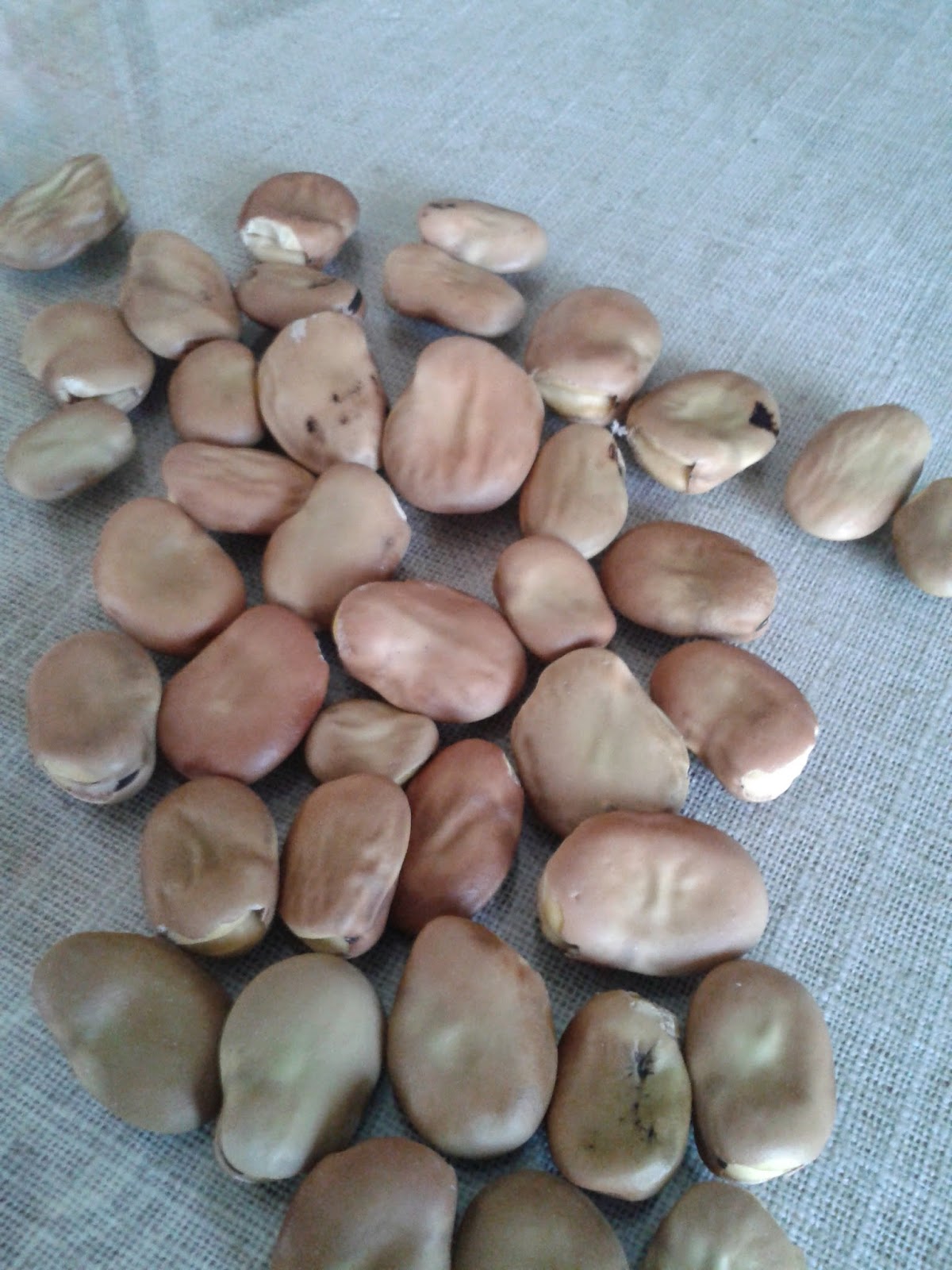
Fava bean though is one of the oldest plant species that were domesticated for mass production in Northen Africa and the surrounding areas and it has been part of the Mediterranean diet for over 6,000 years. It is also known as broad bean for its big and flat shape, compared to other kinds of beans. For certain civilizations the fava bean had symbolic value as well. Given its dark brown color, Ancient Greeks used it as a voting chip, declaring a negative vote, as opposed to a white bean for positive support. In other cultures, fava bean symbolizes good luck, and it is hidden in pies for the fortunate to find. In the Italian-American cultural beliefs, fava bean crops saved the population from starvation in a Middle Ages drought in Sicily, with the blessing of St. Joseph. Thus, Italian-Americans give grace to St. Joseph by distributing food, including fava beans, to the needy, a practice very common in Catholic communities of New Orleans. 

As I was explaining to my visiting friends, old and newly acquired, how to find fava beans in Greek restaurants, I had to clarify a common language misconception. Fava comes from the latin word faba, which means bean and explains perfectly the given name of this peculiar legume. However, if you order fava in a Greek restaurant you will find yourself in the surprising position of receiving a healthy serving of split pea puree, yellow or green, depending on the variety of the seed.

Wierd... or as Greeks like to say "there's a hole in the fava"! The expression refers to the way split pea puree is served, in a deep bowl with a big hole in the middle, which hosts a generous serving of olive oil. The linguistic misconception about the name fava probably stems from the fact that both grains belong to relative botanical families, as well as their similar culinary uses. Fava bean puree, made of cracked beans, slow cooked until they melt and served with the same hole in the middle, is also a common dish in Greece. But isn't any other legume puree, like hummus?

The answer follows in a few days! 

*A big thank-you to Costas Pigadas for enthusiastically contributing to this blog post, with cooking and food styling ideas. 

Friday, February 14, 2014

Fast eater, fast lover?

It was a quiet afternoon at the office and I was engaging in the only multitasking job I am good at: working while eating lunch. My colleague Mary noticed that after 45 minutes I was only half-way through my dish, although I was very productive in my other tasks.

"Seriously, how long does it take you to finish your food?" she asked 

"You know, slow eaters take their time in bed too!" answered a voice in my defense.

Both Mary and I turned in curiosity to see where that voice came from. It could not possibly be Pamela, our other colleague, talking dirty! Pamela was an adorable middle-aged, conservative mother of two well-mannered teenagers, a regular church follower and strong believer in family bonds and moral society. My experience has taught me that when it comes to conservative people Barney in How I met your mother can express it better: "Wait for it"! In other words, you have to be patient, but in the end you will hear an interesting kinky truth coming out of a quiet mouth.

But is it really true that table manners indicate our sex behavior? Popular magazines around the globe give advice on what positive traits to observe on dinner dates and which odd table manners can discourage a person from pursuing a serious relationship. According to their scripts, a tentative host who manages to keep up his eating pace of his invitee appears to be a good choice for a steady relationship, while a sloppy eater signals a rather shady option.

Popular scripts only express a fundamental discovery in the field of psychology, applied in the domain of relationships. Human brain tends to work in power saver mode, thus when it comes to making a decision or profiling a person it uses heuristic cues. This is a fancy word for shortcuts in the decision making process, based on commonly held beliefs. For example, when we are having dinner with a messy eater, we automatically assume that the same mess would appear in every other aspect of her life, including love life. Of course, it is always a matter of choice, whether we want that mess in the bedroom, as word from the streets indicates that sloppy eaters exhibit great creativity and boldness during sex.

Although there is no connection between eating style and sex, behavioral scientist Juliet Boghossian has dedicated her life's work in decoding personal behavior based on food habits. According to her research, fast eaters tend to be productive, but have a problem prioritizing other people's needs, whereas slow eaters most probably cherish every moment and care more for other people than themselves. Based on that, we can easily make inferences from the general behavior to more specialized one, like sexual habits, although science cannot fully support it.

The problem is that when it comes to human behavior neither science nor Cosmopolitan magazine can accurately predict it. There are always indicators of general behaviors, but keep in mind that outliers or deviations are not just numbers and noise to mathematical models. In reality, those outliers are distinct personalities that you may encounter and have a deep impact in your life.

Too much scientific jargon? Maybe. In real life we do not need that in abundance. Trust me, I am a scientist, I know. Thus, when you are on a date, stop over-analyzing your partner's eating behavior and just enjoy the moment, or at least enjoy your meal. If a fast eater fits into whatever model and is indeed a fast lover, you always have a choice to walk away, if that is not what you were looking for. No science and no relation advice column can explain those butterflies in your stomach, the  euphoria of meeting your loved one, the satisfaction of a well accomplished date. Always ask: what does your gut tell you? After all, the stomach is usually a reliable adviser.

Happy Valentines Day!

Thursday, February 6, 2014

I love tacos!

"I love tacos!" This might sound like a cheesy statement for a Mexican restaurant advertising campaign. For me, it was my punishment for leaving my laptop unattended and my social media accounts a facile target to my friend Ani. Ani would just swarm to my computer and leave an tasty message for the public to read, a message that drew from her Mexican roots and our mutual appetite for tacos. Thinking back, my friendship with Ani has been marked by this small tortilla folded Mexican delicacy. 


Dictionaries and other reference scripts describe a taco as a popular Mexican food, comprised of a tortilla wrapped around a filling. Food historians locate the root of this delicacy back to the Aztecs and the Mayans, civilizations that used flat breads to wrap their food. Truth to be told, wrapping food around a piece of dough is a common cooking and serving practice in almost all civilizations around the globe. 

Historian Jeffrey M. Pilcher supports that the word "taco" started being a proper name for the food we know today around the 18th century from a group of Mexican silver miners. For them, a taco was a piece of paper used to wrap gunpowder to create excavating charges. Apparently, those miners found visual similarities between their bread-wrapped food and the little paper pouches. Not to mention the fiery taste effect of the chilies they used abundantly in their food, which reminded them of the explosion of rocks, caused by the small dynamite bags. Thus, taco, the plug, became taco, the tortilla wrap.

Tacos have always been associated with open air, as it is considered the ultimate street food, along with hot dogs. In the beginning of the 20th century the Chili Queens were selling tacos out of their carts in the South boarders of the American soil. Although the dish has gone many culinary changes since then, like the introduction of hard shell corn tortilla in 1947, and can be served in many restaurants, from a humble Mexican joint to award-winning restaurants, still it tastes better if it comes from a truck. And that is something I learned from Ani.

In one of our trips, our quest for the perfect taco bite brought us to Pasco, a small picturesque town in Washington, with a considerable community of Mexicans. Our friends back home suggested this town as the place to find the "original Mexican taco". Ani and I decided that if that was the case, it was worth to make an hour detour to taste a piece of her culture. I can never deny a foreigner to seek for their roots, being away from home myself, thus I agreed to have a friendly encounter with this new and exotic culture. 

The minute we entered Pasco, there it was! A taco truck. I do not know if it was my bad first impression of the place or my sightseeing itch, that I suggested we go a bit further into town to find a better place.

"NO!" Ani cried. "This is the place. This is the original taco truck. You can't get anything more Mexican than that. Trust me, I am Mexican."

Since I was holding the wheel of the car, I ignored her and kept driving into a town that had no other obvious taco place. I pulled into a parking lot, approached a group of Mexican and Ani asked them where we can find good tacos. The answer shocked me.

"If you turn around, there is a great taco truck at the beginning of the town".

I do not know what was screaming louder "I TOLD YOU SO!", words or Ani's facial expression, which led to an insane blabbering, from which the only thing I could hear was "tacos". 

"Stop! I'm driving, you are distracting me and I'll make a serious mistake" I asked her in a demanding voice. It was only one second after finishing my sentence that I realized I was crossing the road on a red light. Higher powers must have really wanted me to try those damn "original tacos" that we did not cross paths with the incoming vehicles!

I do not remember how the Pasco tacos tasted. Probably they did not make a lingering impression on me and I definitely had better ones. The little adventure in that small town though marked my life and my memories of the US and Ani. At the risk of sounding like a cheesy Mexican restaurant advertising campaign, I can say out loud "I love tacos"!

Monday, January 20, 2014

The creamy tale of two cities

Once upon a time there were two cities, Athens and Salonica. The first was named Capital of the Country, the second Capital of the North. One would wish that those two cities co-existed and go in peace. However, the tale of the two cities does not follow the bourgeois plot of a Dickinson novel, but rather a Bothers Grimm tale.

"Magic mirror in my hand, who is the fairest in the land?"

The mirror glorifies the beauty of both, but in the end it is the young princess that wins the favor and is named Nymph of the North.

In the real world, the fight between the two biggest cities in Greece is taking place in many fields, with the most prominent being the sports arena. Nevertheless, the most interesting battle, which is traveling into the sphere of urban legends, is the linguistic one. 

"What is the proper name for yellow cheese?" How do you drink a frappé coffee?" When you say souvlaki, what does that include?"

And the mother of all questions: "What is a bougatsa and what is in it?" 

Bougatsa filled with custard cream

Bougatsa is a pastry that came in the Greek mainland along with the refugees of Smyrna and Constantinople in the beginning of the 20th century. The main ingredient is a very thin oil-based dough, close to what is today known as fyllo dough. History teaches us that the recipe for this dough, as well as for fyllo dough, was a creation of the great culinary minds in Top Kapi Palace, the center of the Ottoman Empire. Thus the name of bougatsa derives from the Turkish word boğaça for dough. As a matter of fact, many dough-based foods of the European area have names of the similar root, like the Italian focaccia.

Bougatsa custard cream in the making
War brought in the North of Greece many families with the well-hidden recipe for bougatsa. At first, bougatsa was made only of dough, thinly rolled and stacked, baked to crisp perfection and sold by moving carts in the neighborhoods. The low cost of ingredients (only flour, water and oil) made it a cheap treat for people of low means, a condition that gave bougatsa its first name: the pie of the poor. Later, in other regions, like Serres, pastry chefs decided to enrich it by filling it with cream, either a custard or a cheese-based cream. This particular twist in the recipe turned a simple dough into one of the most famous Greek pastries, traveling on the fast lane from the cold corners of the north to the warmer climates of the south. Nowadays, it is part of the traditional cooking and in many places bougatsa is served in special occasions, like in Heraklion, Crete where it is served on New Year's Day to farewell the old year.


Sign on a pastry shop window in Crete calling people to buy bougatsa on for New Year's Day

But, no matter how far the pastry traveled, it grew roots in Salonica and became the city's signature dish. Throughout the years cooks gave their own versions of the pie, so that locals end up calling every phyllo pie a bougatsa. And here's where the linguistic dispute with Athens is located, as for Athenians bougatsa can only be filled with cream. Lack of culinary imagination in the South or an inexhaustible cooking freedom in the North? No one can answer the question with certainty, but the dispute over a piece of bougatsa has become a living legend in the history of the two cities. 

Bougatsa compliments well Greeks' favorite pastime of drinking coffee

As for my personal opinion, I would have to agree with the mirror. Salonica gets my vote and the fact that bougatsa is one of my favorite sweet dishes plays a major role in my decision. But most of all, I am drawn by the enchanting atmosphere of the city, the cool disposition of its people and the distinct culinary identity of the North expressed in the served dishes.

Thursday, October 31, 2013

The pumpkin spree

Every fall my mother was baking a pie. First she rolled thin sheets of dough. Then she filled them with some orange mixture. She baked the pie and then... the big chase begun. My mother was employing every tutoring technique to make me try her pastry, even the notorious "try it and if you don't like it spit it out". Even though the pie smelled deliciously, that yellow substance looked creepy, so that it was difficult for me to give any credit to my mother's effort. The "creepy" filling was made of pumpkin, which is in season during fall.

It wasn't until I moved to the US that I experienced my first Halloween and I realized that the symbol of the festivities is the pumpkin. Spooky fact, while motherly care was not enough to convince me to try pumpkin, Halloween creepiness did.


First it was my neighbor, whose effort to apologize for the noise next door brought a pumpkin on my table as a peace offer. Not knowing what to do with this round vegetable I thought it might be a brilliant idea to bake a cake, incorporating some of the pumpkin in the batter. Pureeing the pumpkin was the easy part of the endeavor. The problem was that I had never baked a cake before. 
"Try a box cake!" suggested a friend and working mother of two adorable little devils.

And so I did. The result was so thrilling that it made me try pumpkin, and adore it. The puree of a freshly baked pumpkin gave the pastry such moist that it transformed a blunt box cake into a delight.

"Shame on you!" my mother cried when I bragged about my achievement over the phone. "A nice Greek girl should at least know how to bake something as simple as a cake" she continued. All of a sudden Halloween became even creepier. However, I never complained because I gained three valuable lessons from my first ever Halloween.

First, I learned to appreciate the earthy taste and the distinct aroma of a pumpkin. Second, my mother's howler was enough to motivate me to learn how to bake a cake from scratch, an effort that was encouraged by my roommate, who gave me an electric mixer and a bundt cake mold. Those gifts became valuable companions in my future baking efforts and stayed with me longer than my roommate. Third, I learned how to carve pumpkins with spooky themes, a fun activity that I continue until these days.
 
After that Halloween pumpkin cake baking spree took over my soul. I was baking constantly, experimenting with batters, baking techniques and spice mixes. The only ingredient stayed steady was the pumpkin. 

A few years later, in an outing my friend Cari announced that it was her birthday in a couple of weeks. "I'll make you a cake" I suggested firmly. I am not sure what series of thoughts was crossing my brain at that moment, but I was in serious trouble, as baking a birthday cake has never been my forte. As a matter of fact, the only cake I have ever baked was (surprise...) pumpkin cake. In the panic that had captured my body, I realized that perhaps that was the solution. 

The original Cari cake
So I baked a pumpkin cake, filled in with a simple cocoa whipped cream and decorated with chocolate syrup and a tealight candle on top. Perhaps that was not my brightest culinary moment, but it made Cari happy. Hence, the Cari cake was born!

Wednesday, September 11, 2013

The dirty story behind gyro


There were two questions that were popping in people’s minds the minute they knew I was Greek.

Question number one: how do you pronounce your last name? I wonder why? My last name only has 14 letters!

Question number two (which was usually asked by people who did not know my last name): How do you say “gyro” in Greek? This is a question that has been tormenting the Americans since the introduction of gyro, in Chicago in 1965, or probably a little later in the 1970s, when the mass production of gyro started on US soil.

Linguistically, the word gyro (or gyros) is the greeklish interpretation of the word γύρος, which means spin or turn. Gyro is big chunks of meat skewed on a vertical spit, which rotates near a heating source and slowly cooks the meat around. Gyro is usually served on pita bread, with chopped tomato, sliced onions and tzatziki, a yoghurt based sauce with cucumber.

Gyro is the most famous street food in Greece, along with the souvlaki, which is cubes of pork meat of a skewer. However, the way it is prepared and served in the US is completely different with the way it is enjoyed in Greece. There are four key points that mark a clear distinction between the two gyro sandwiches.


Fact #1: Gyro is not made of lamb. At least not in Greece. There is a perception that Greeks eat only lamb and goat meat. It is true that lamb is a key protein in the Greek diet due to environmental factors. The Mediterranean basin has a rather dry climate and the vegetation is not as rich as the green pastures of Northern Europe. Consequently, raising cows is very expensive, whereas the production of lamb meat is economically justifiable. As a matter of fact, lamb meat is featured in the majority of festive dishes in Greece, like the lamb on the spit for the Easter celebrations.

 Another common meat used in the Greek diet though, is pork. Pigs are the next non-expensive animal to raise, as they are omnivores, thus they can eat anything, including leftovers. However, they need a big quantity of food for their diet, so they cost more to raise than sheep. Nevertheless, the gyro in Greece is traditionally made from pork meat. The closest dish to gyro on the culinary map is Mexican al pastor, if we skip the pineapple and the hot spices. Other world cuisines that feature similar dishes have alternative choices of meat, like the Turkish döner kebab, which is made of beef and the Middle Eastern shawarma, which is prepared with a mix of roasted meat.

Fact #2: There is no feta cheese in a gyro sandwich. Moreover, adding feta to any dish does not automatically make it Greek! I always remember the expression of curiosity mixed with disappointment when I was leaving feta out of my gyro sandwich. “No feta? Why? But you are Greek!” That was the usual question following my order.

Greek gyro sandwich, with french fries, onion mustard and ketchup
Feta cheese is a POD Greek cheese, made of sheep milk or a blend of sheep and goat milk. It is the most famous Greek cheese around the world and its name is indicative of its origin. It is vastly used in Greek cuisine, but when it comes to local cooking, it hardly makes the list of the top 5 most commonly used ingredients. To speak the truth, Greek cooks have a vast variety of cheeses to choose from for their cooking, that feta is simply another delicious cheese.

When it comes to the complimentary ingredients in a pita sandwich, the choices are simple. French fries are best friends with gyro meat. For freshness salad is added, which is sliced tomato and onion. The only dairy product is the famous tzatziki. No feta, no other cheese. Plus, for the last 30 years or so, we like to add ketchup and mustard in our sandwich for more flavor. And that is the holy trinity of gyros: tzatziki, ketchup and mustard!

Fact #3: The secret of a flavorful gyro is in the fat. Greek gyro makers alternate on the spit chunks of meat with pieces of fat. That fat melts and moistens the meat, creating a desirable crispiness on the outside and caging all the juices inside of the gyro meat. The vertical position of the spit facilitates the process and the biggest amount of the juice stays inside the meat. When the outside is crusty the carver sharpens his knives and trims the crispy parts into thin chunks of juicy meat. 

In the US though, the trend is to avoid fatty food. I was very surprised to come across unhealthy food, like potato chips, advertised as containing zero trans fats, implying that it is healthy. This gave me a good excuse to consume numerous bags of potato chips, my gastronomic weakness, but without the guilt of eating unhealthy food the pleasure was not the same. The mass production and storage of gyro cones made it difficult to prepare this food the traditional Greek way. For such a cone, beef and lamb trimmings are mixed with breadcrumbs and a mix of spices and a processor turns it into a giant cone-shaped burger. When it is roasted, the carver trims long burger stripes for the gyro sandwich. 


Greek-style gyro vs. American style gyro on a rotisserie


It is this difference in the preparation and the choice of meat that make the flavor of the two gyro sandwiches different. Most of all, it is the lack of fat in the American style gyro that deprives the delicacy of the necessary guilt to enjoy it.

Fact #4: The best way to enjoy a gyro sandwich is by hand. I had been on a date once and the prospective boyfriend took me to a gyro shop. I thought that on a first date it was proper to show my good manners and I ate my sandwich like a lady using a fork and a knife. I made it through the entire date without a drop of grease on my fingers or a stain of sauce on my clothes. I disregarded the weird looks on the gentleman’s face and mistakenly thought that I had a successful first date. Nevertheless, I never had a chance for a second date. Apparently a fork and a knife were not the appropriate etiquette for gyro eating. After this doomed date, in one of the conversations I had with my friend Maria, a faithful fellow gyro eater, we agreed upon one conclusion. Gyro is like sex. The messier you get, the more you enjoy it.

This typical Greek street food is among the most popular choices for the bar night owls. The canteens and food trucks that serve this food after the bars and clubs are closed are commonly known as “vromiko”. The word stands for dirty, but it has nothing to do with the quality or the sanitation of the served food. The word vromiko indicates that the food is so sinfully delicious and succulent that it is enjoyed with a serving of guilt for the mischief you are about to commit. Since there are no sitting tables, there are no utensils either. Thus, the gyro is consumed the traditional way, with the sandwich in one hand and a pile of paper napkins in the other. No worries about messing up your hands or staining your brand new shirt. All the happy faces around the food trucks and gyro shops, along with my failed first date, have shown me that improper eating manners are the proper etiquette for enjoying this exquisite food.
 
Gyro is the food I missed the most while living in the US.  It might be considered as street food, but for me it is equivalent to comfort food, as it fills my soul with pleasure. For closing, watch the history of the American-style gyro in Alton Brown's humorous perspective.